AI and Schoolwork: Where Is the Line Between Help and Cheating?
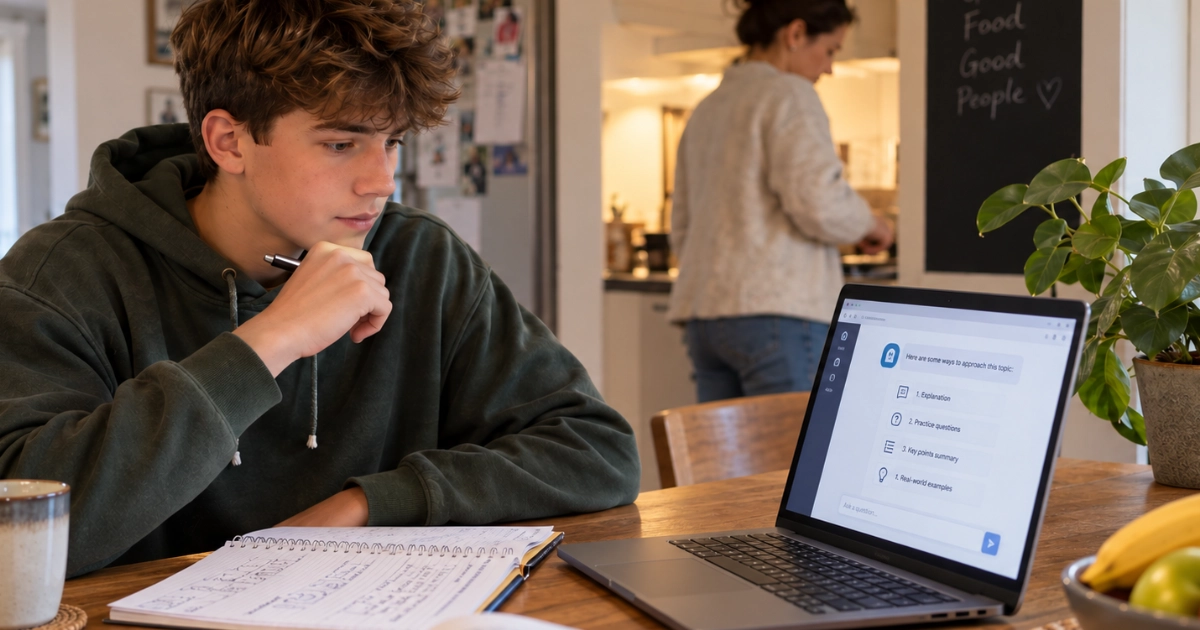
AI can explain a difficult topic in a different way, make practice questions and give instant feedback. It can also write an apparently convincing assignment in seconds.
For parents and students, the difficult question is where useful help ends and someone else doing the work begins.
The answer depends partly on the task and the school's rules. A homework exercise, a practice essay and GCSE or A level coursework may have different requirements. But there is a useful starting point.
The starting point
The work a student submits should show what they know, can do and have worked out. If a student couldn't explain their answer and how they arrived at it without the AI beside them, the tool has probably done too much.
Use AI to learn, not to skip the learning
Imagine a student who doesn't understand a topic from a lesson. They might ask an AI tool to explain it more simply, give them an example and then quiz them without revealing the answers. They check anything important against their class notes or a reliable source, and write their own response. That can be a productive way to study, where their school permits it.
Now imagine asking the tool to answer the homework question, then changing a few words before handing it in. The student may have a finished piece of work, but they have missed the practice the task was meant to provide. If it is assessed coursework, submitting AI-generated analysis or paraphrasing it as their own can be treated as malpractice.
The middle ground needs more thought. Asking for feedback on a paragraph may be useful. Asking an AI tool to rewrite the paragraph beautifully may mean the final wording no longer reflects the student's ability. An essay plan can help someone get unstuck, but if the tool supplies the argument, evidence and structure, how much of the thinking is still theirs?
A spellchecker, a grammar suggestion and an AI rewrite are not necessarily the same level of help. Check the rules for the particular assignment, and ask the teacher before using AI where the answer isn't clear.
Where the line tends to sit
Every school and subject sets its own rules, so this is a way of thinking rather than a rulebook. The pattern is fairly consistent, though: the further right you go, the less of the work is the student's own.
| Usually fine | Think carefully | Not their own work |
|---|---|---|
| Explaining a topic another way | Feedback on a draft they wrote | Writing the answer or essay |
| Making practice questions and quizzes | Suggesting an essay plan or structure | Supplying the argument and evidence |
| Checking understanding after revision | Rewriting their sentences more elegantly | Doing the analysis or the calculations |
| Suggesting where to read more | Translating source material | Paraphrasing AI text to hide where it came from |
For anything in the middle column, the safe move is the same: ask the teacher what is allowed for that particular assignment, before starting rather than afterwards.
Translation tools count too
Translation tools deserve the same care. They can do much more than look up an unfamiliar word.
In a case published in the Joint Council for Qualifications (JCQ) guidance on AI use in assessments, an A level Art and Design student researched in their first language and used DeepL to translate the material into their sketchbook without acknowledging it. The result was a loss of marks that left zero marks for that component.
That doesn't mean every use of translation is forbidden. It means students should check the rules for assessed work and declare permitted help, even when a tool feels like an ordinary study aid.
What do schools' AI detectors actually tell them?
Some schools use software that estimates whether passages of writing resemble AI-generated text.
A detector cannot see how a document was made. It analyses the submitted text and produces an indication, which may be wrong in either direction.
Turnitin, one of the best known, says its AI writing detection "may not always be accurate" and "should not be used as the sole basis for adverse actions against a student". It also notes a higher rate of false positives at the low end of the scale.
Detectors can also be fooled. AI-generated text that has been edited or mixed with a student's writing may be harder for a tool to identify, though some tools also attempt to spot AI text altered by paraphrasing software. Conversely, a student can write a piece entirely themselves and still be flagged.
A low score is not permission to pass off AI work as your own, and a high score is not proof of cheating.
That doesn't mean misuse is impossible to notice. A teacher who knows a student's work may see an abrupt change in vocabulary or style, confident claims that don't answer the question, references that cannot be found, or an answer the student struggles to explain. Teachers may also have seen the drafts and discussions that led to the final submission.
These are reasons to ask questions and look at the full picture, not grounds to accuse someone from a writing style alone.
Trying to make AI writing "undetectable" misses the point. Even when software doesn't flag it, a student still risks submitting work they cannot defend, learning less than they need for an exam, and breaking the rules for assessed work.
Coursework needs particular care
For GCSE, A level and many vocational qualifications covered by JCQ guidance, students must submit their own independent work.
JCQ says that copying or paraphrasing AI-generated material so the submission is no longer the student's own, using AI to do the analysis or calculations, and failing to acknowledge AI used as a source of information can all amount to misuse. Depending on the case, sanctions range from a warning or loss of marks to disqualification and being barred from entering examinations for a period.
Acknowledging AI use is important, but it does not turn an AI-written answer into the student's own achievement.
What JCQ expects when AI is used as a source
- The name of the AI tool and the date the content was generated
- The question or prompt used, and the AI's response, kept in a non-editable form such as a screenshot
- A brief explanation of how it was used
- All of it submitted with the work
Verify factual claims and references independently. AI can invent sources that look entirely plausible, and citing a book or article that doesn't exist is its own problem.
Rules may differ between schools, subjects and assignments. The International Baccalaureate, for example, sets out ethical use and proper attribution rather than a blanket ban, and has said teachers should see work develop over time and satisfy themselves that a student can explain it.
So don't rely on a friend's account of what was allowed for a different piece of work. Read the instructions for this task, or ask the teacher.
A sensible approach for families
- Ask what the task is testing. If it is meant to practise forming an argument, don't let AI form the argument. If it is revision, a quiz or an alternative explanation might help.
- Agree how AI will be used before starting. "Help me understand this concept" is a clearer boundary than "help me with my essay".
- Check the school and subject rules. This matters most for coursework and other assessed submissions.
- Keep a record. Save drafts and notes. For assessed work where AI is permitted as an information source, follow the formal requirement to submit a non-editable record of the prompts and output with an explanation of how it was used.
- Check facts and references. Never cite a book, article or quotation merely because an AI tool supplied it.
- Talk early if there's a concern. If a student has used too much AI, or worries that genuine work has been flagged, speak to the teacher and show how the work was produced. For JCQ assessments, a concern raised before the declaration of authenticity is signed can be handled by the school under its own policy. After it has been signed, suspected misuse must be reported to the awarding organisation.
None of this needs to be a fight. Most students are not trying to cheat. They are trying to finish something difficult at half past nine on a Sunday evening, and the tool that offers to do it for them is right there.
A family agreement you can print
Stick this on the fridge or inside the homework folder, and fill in the blanks together.
AI and Homework: Our Agreement
Before starting a piece of work
- What is this task actually testing? ____________________
- What do the school's rules say for this subject? ____________________
- Is it assessed coursework? If so, check before using AI at all
- If it isn't clear, ask the teacher first
What AI is for in this house
- Explaining something a different way, and making practice questions
- Checking understanding, not producing the answer
- The words handed in are the student's own
- Facts and references are checked somewhere reliable
Before it is handed in
- Could I explain this answer, out loud, with the laptop shut?
- Any permitted AI use written down: tool, date, prompt, output, how it helped
- Drafts and notes saved, in case anyone asks how it was made
- If something has gone wrong, say so early rather than hoping
The test that matters: does this work leave me more able to do the next one on my own?
AI is likely to be part of students' working lives. Learning how to question it and use it honestly is worthwhile. For schoolwork, the best use of AI is one that leaves the student more capable of doing the next task themselves.
For the view from the other side of the classroom, there is a practical guide to AI tools for teachers. If you are new to these tools yourself, ten useful things you can do with free AI is a gentler starting point, and parental controls covers the wider question of what children can reach online.
Where these rules come from
All of this was checked in September 2026. If you would rather read the guidance itself than take our word for it:
- JCQ: AI Use in Assessments, the exam boards' joint guidance, including the case studies and the acknowledgement requirements
- Ofqual: AI in coursework, resources for schools, written for teachers and school leaders
- Turnitin: using the AI writing report, including its own warnings about accuracy
- International Baccalaureate: AI in learning, teaching and assessment, including its academic integrity policy
- International Baccalaureate: the Director of Assessment on AI and authentic student work, on why it chose guidance over a ban
Need help getting started with AI at home?
Marple Tech Help can show families how these tools work, set up accounts sensibly, check the privacy settings and talk through what they are good and bad at. A Tech Confidence Session is £69, at your kitchen table, at whatever pace suits you.
One thing I cannot tell you is what is allowed for a particular assignment. That is your child's school, every time. What I can do is make sure the technology side is set up properly and understood, so the conversation at home is about the work rather than the gadget.
I’m based in Marple and cover Stockport, SK6 and the surrounding area.