How to Store Old Tapes, Cassettes, Photos and Slides So They Last
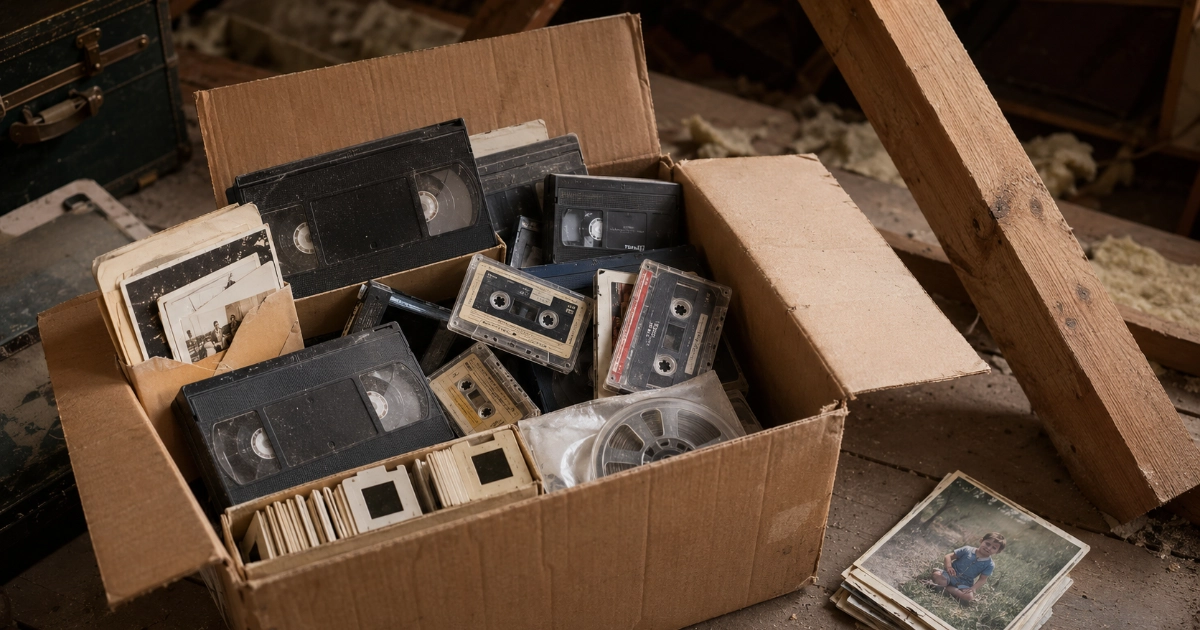
Most of the damage I see in old family media was not caused by playing it. It was caused by where it sat for thirty years. The good news is that better storage is mostly free, and it buys you time.
There is an honest caveat worth saying up front, because it shapes everything below. Careful storage slows decay down. It does not stop it. Magnetic tape, colour film and photographic dyes all change chemically as they age, whatever you do, and the machines needed to play tape are getting scarcer every year. So the realistic goal is this: store things well so nothing is lost in the meantime, and digitise the irreplaceable ones before they need rescuing rather than after.
The short version
- Cool, dry, dark and stable beats warm, damp or fluctuating every time.
- Lofts and garages are the worst places in most houses. An interior cupboard is far better.
- Store tapes and cassettes upright, like books on a shelf, not stacked flat.
- Never freeze tape, and do not use PVC or "magnetic" sticky albums for photos.
- Some warning signs need acting on quickly. A vinegar smell or visible mould are the urgent ones.
The four conditions that matter
Archives spend a lot of money controlling four things. You cannot match a professional archive at home, and you do not need to. Moving your box from a loft to a wardrobe already captures most of the benefit.
1. Temperature: cooler is better
Chemical decay speeds up as things get warmer. Archive guidance puts magnetic tape at roughly 10°C to 18°C and photographs below about 24°C. A normally heated room is acceptable. A loft that hits 40°C in a July heatwave is not.
One important exception: do not freeze tape. Freezing gets suggested online as a fix for sticky tape. It is not a home remedy, and archives explicitly advise against freezing magnetic media.
2. Humidity: dry, but not bone dry
Damp is the single biggest enemy. Around 30 to 40 percent relative humidity is the archival target for tape, and staying below 65 percent is the practical threshold for avoiding mould on photographs. High humidity drives the chemical reaction that ruins tape binder, and above roughly 65 percent you risk mould growth on almost everything.
3. Stability: avoid the swings
Repeated cycling between hot and cold, or damp and dry, does more harm than a steady temperature slightly higher than ideal. Materials expand and contract, and moisture moves in and out. A cupboard that stays roughly the same all year is better than a room that swings wildly.
4. Darkness and clean air
Light fades photographic dyes permanently, and ultraviolet light is the worst. Keep originals in the dark and display copies instead. Dust is abrasive on tape and film, so closed boxes beat open shelves.
Where to store things in a normal house
Ranked from best to worst, for a typical UK home:
This is not just my opinion. The National Archives advises specifically against storing photographs in an attic or basement, or against the outside walls of a building, because those are exactly the spots prone to temperature extremes, damp and condensation. British houses are very good at producing all three.
If a loft or garage is genuinely your only option, prioritise: get the handful of truly irreplaceable items out of there and into the house, even if the rest has to stay put.
Video tapes and audio cassettes
This covers VHS, S-VHS, VHS-C, Video8, Hi8, Digital8, MiniDV and ordinary audio cassettes. They share the same basic construction: a magnetic coating held onto a plastic ribbon by a binder, wound on spools inside a shell.
What helps
- Store them upright, spine out, like books. Long-term flat stacking puts uneven pressure on the tape pack and the weight of a tall stack can distort the shells.
- Keep them in their cases if you still have them. Cases keep dust off and stop the shells cracking.
- Rewind fully before storing, so the tape sits evenly wound on one spool rather than parked mid-reel under tension.
- Keep them away from magnets and motors. Speakers, older CRT televisions and mains transformers are the usual culprits. In practice this is a smaller risk than damp, but it is free to avoid.
- Do not overtighten anything, and do not oil anything. There is nothing on a domestic tape you should be lubricating.
What causes damage
Damp is the main one. Moisture drives a reaction in the polyurethane binder called hydrolysis, which in the worst cases produces what is known as sticky-shed syndrome: the coating turns gummy, squeals across the heads, sheds a brown residue and can shred during playback.
Worth being precise here, because there is a lot of loose talk about this online. Classic sticky-shed is mainly a problem of certain open-reel tape stocks from the 1970s and 1980s. Domestic audio cassettes were generally made with different binder formulations and are much less prone to it, although some cassette stocks do develop a related stickiness as lubricants migrate to the surface. Either way, the practical advice is identical: keep them dry, and if a tape squeals or drags, stop playing it.
A note on playing old tapes. If a tape has been in a loft or garage for years, the first play is the riskiest moment in its life. A tape in poor condition can be damaged permanently, or can shed enough residue to clog a machine and damage the next tape you play. If something sounds or looks wrong, stopping is nearly always the right call.
Printed photographs
Prints are more robust than tape, but they have their own specific enemies.
The album problem
Two very common album types actively damage photographs, and both were sold in enormous numbers.
- PVC or vinyl sleeves. These give off acidic compounds as they age, which stain and fade prints. You can usually recognise PVC by a faintly oily feel and a distinct plastic smell. The National Archives here in the UK lists PVC among the storage materials that cause deterioration.
- Self-adhesive "magnetic" albums. Also on that list, and for good reason. The sticky page and its plastic film yellow over time, and the adhesive can bond to the print so firmly that removal tears it. These are the albums that most often produce photos I cannot feed through a scanner.
If you have either type, that is a good reason to act sooner rather than later. Do not force photographs out of a sticky album. If a print does not lift away easily, leave it attached and get advice.
Better materials
Look for acid-free paper enclosures, or sleeves made from polyester, polypropylene or polyethylene. Archival suppliers describe products that have passed the Photographic Activity Test, usually shortened to PAT, which is a reasonable shorthand for safe.
Handling
- Hold prints by the edges. Fingerprints contain oils and salts that etch in over time.
- Never use paperclips, staples, sticky tape or rubber bands. All four cause permanent marks.
- Write on the back only if you must, in soft pencil, at the very edge. Never ballpoint or marker, which can emboss or bleed through.
- Store prints flat if they are large, and upright in boxes if they are small and numerous.
Slides, negatives and cine film
Film is where the clock ticks loudest, because a lot of twentieth-century film was made on a cellulose acetate base that decays chemically.
Vinegar syndrome
As acetate breaks down it releases acetic acid, which is what gives vinegar its smell. Hence the name. The smell usually arrives before any visible damage, so your nose is a genuinely useful diagnostic tool here. As it progresses, the base shrinks while the image layer does not, so the film buckles, ripples and eventually separates in what is described as channelling. Heat and humidity both accelerate it considerably.
It is also somewhat self-catalysing and the acid affects neighbouring film, so an affected reel or sleeve is best stored separately from healthy material rather than in the same sealed box.
Colour fade
Colour dyes are not permanently stable. Colour negatives, slides and prints kept at ordinary room temperature can visibly shift and fade within decades, which is why old slides so often look magenta or orange now. Cooler storage slows this down. Nothing reverses it in the original, although a good scan plus careful correction recovers a surprising amount.
Practical steps
- Keep slides and negatives in inert sleeves or purpose-made boxes, not loose in tins or envelopes where they scratch each other.
- Store glass-mounted slides and glass plate negatives vertically, unless they are already cracked, in which case flat and supported.
- Keep cine reels in their cans but do not seal them airtight, since trapped acid vapour accelerates decay.
- Cooler is genuinely better for film than for anything else on this list. A cool interior cupboard is ideal.
For a sense of the scale of this problem, the BFI National Archive holds well over a quarter of a million cans of acetate film, a great deal of it at risk from vinegar syndrome, and its approach is the same as the one recommended here: cool, dry storage to delay the decay, and digitisation prioritised for the reels already showing symptoms. Passive storage buys time. It does not reverse anything.
DVDs and CDs
Home-recorded discs are worth a special mention because people assume they are the safe copy. They often are not. Unlike shop-bought pressed discs, recordable CDs and DVDs store data in an organic dye layer that degrades over time, faster in heat, humidity and light.
The important point is how much the quality varies. Accelerated ageing studies by NIST and the Library of Congress found predicted lifespans for recordable discs ranging from as little as five years to over a hundred, depending entirely on how the disc was made. Premium discs may well outlive you. A budget blank from a spindle of fifty in 2004 may already be unreadable. Since you generally cannot tell which you have by looking, a home-recorded disc is not a copy worth relying on.
- Store discs upright in cases, not stacked bare or in paper sleeves that scratch.
- Hold them by the edge and centre hole, and keep the underside clean.
- Never write on the data side, and avoid solvent markers even on the label side.
- Keep them out of sunlight, which attacks the dye layer directly.
- If a home-recorded disc holds something irreplaceable, treat it as a temporary copy and get the contents onto modern storage.
Warning signs and how urgent each one is
If you are going through a box, these are the things worth looking and sniffing for. The urgency column is my practical view, not a formal conservation standard.
On tape, film or prints. Mould feeds on gelatin and binder and spreads to whatever is stored alongside it. Isolate the affected items in a separate bag or box, keep them dry, and do not play a mouldy tape. Playing it spreads spores through the machine and can damage the next tape.
The signature of acetate decay. It gets worse with time and affects nearby film. Separate the smelly items, move them somewhere cool and dry, and prioritise digitising them.
Flood, leak or condensation. Do not seal wet items in plastic, which guarantees mould. Keep them cool, let air circulate, and get advice quickly. Prints stuck face to face are a specialist job and forcing them apart destroys the image.
A sign of tape deterioration or contamination. Stop playing it. Each pass sheds more of the coating, and the residue transfers to the machine.
The adhesive is only going to bond harder. Leave them attached and get advice before anything tears.
Usually acetate shrinkage. Still often scannable at this stage. Considerably harder once the image layer starts lifting away from the base.
Dye fade. Not urgent in the sense that it will not suddenly collapse, but it is one-directional and never improves. Scanning captures what is left and correction often recovers a lot.
No visible mould yet, but the conditions for it are present. Move everything somewhere drier and check items individually.
Mechanical rather than chemical, and often repairable. The recording underneath is frequently perfectly fine.
Labelling, and why it matters more than you think
This is the part people skip, and it is the part families most regret. A perfectly preserved tape labelled "Holiday" is worth much less than a slightly degraded one labelled "Whitby, August 1987, Mum's 40th".
The people who know who is in the pictures will not always be around to ask. If there is an older relative who can still identify faces and places, that knowledge is more perishable than the media itself.
- Write on the shell label or case, not on the tape or film.
- Names, place, rough date. "Late 80s" is far better than nothing.
- For photographs, soft pencil on the back edge, or number the sleeve and keep a separate list.
- A single sheet of paper in the box listing what is in it is worth doing before anything else.
When storage is not enough
Everything above buys time. It does not stop the clock, and there is a second problem that no amount of careful storage solves: the machines. Working VHS players, camcorders for Video8, Hi8, Digital8 and MiniDV, cassette decks and cine projectors are all becoming scarcer, and the pool of people able to service them is shrinking too. A tape in perfect condition is still unwatchable if nothing exists to play it.
That is the honest case for digitising. A digital copy can be backed up in several places, checked and copied onto new storage when needed, and shared with the whole family. Duplication and migration are the real advantages, not permanence: a hard drive or USB stick will fail eventually too, but unlike a tape you can make a perfect copy of the contents before it does. The original stays as the original, and the digital copy becomes the one you actually use.
If you are wondering where to start, start with whatever is irreplaceable and whatever is showing warning signs. A wedding cine reel with a vinegar smell is a different priority from a box of off-air VHS recordings.
What I can digitise locally in Marple
Video tapes & DVDs £10 each · Photo & data discs £5 each · Audio cassettes £10 each · Printed photo scanning from £10 · 35mm slides & negatives from £15. Printed photo scanning: From £10 for up to 50 photos. Standard prices apply to loose photographs suitable for automatic feeding. Fragile, curled, damaged, sticky, mounted or album-bound photographs need individual assessment and a separate quote. Manual photo restoration is not included.
Everything is handled here in Marple by me, start to finish. Nothing is posted away to a bulk processor, and your originals come back to you. Full details are on the Marple Memories page.
If you have found something worrying in a box, you are welcome to just ask. A photo on WhatsApp is usually enough for me to tell you what you have got and whether it needs dealing with urgently or can safely wait.
Related reading: Why now is the right time to digitise old family tapes, slides and negatives covers the formats I handle and how the process works.
Found something in a box that worries you?
Send me a photo and I’ll tell you what you’ve got, whether it needs dealing with urgently, and what it would cost.
Local handling in Marple. One person from start to finish. Originals never posted away.
I’m based in Marple and cover Stockport, SK6 and the surrounding area.
Sources and further reading
Preservation science is international, so the guidance below comes from archives in several countries. The advice is consistent between them. UK sources first, since the conditions they describe are the ones in British homes.
UK
- The National Archives: Caring for your photographs (PVC and self-adhesive albums, pencil labelling, why lofts and cellars are unsuitable)
- The National Archives: Top tips for caring for photographs
- BFI National Archive: Care of the collections (cool dry storage for acetate film, vinegar syndrome)
- BFI: Digital preservation of the UK's videotape heritage (why analogue video is time-limited)
- Greatbear, Bristol: Binder problems and sticky-shed syndrome
International
- IASA: Sticky Tape and Sticky Shed Syndrome (binder hydrolysis, and why cassettes differ from open-reel tape)
- Canadian Conservation Institute: Longevity of recordable CDs, DVDs and Blu-rays
- US National Archives: Machine-readable media (tape temperature and humidity figures, and not freezing tape)
- CLIR: Magnetic tape storage and handling guide
- NIST and Library of Congress: Optical disc longevity study